
Import, Export, Self-Reliance
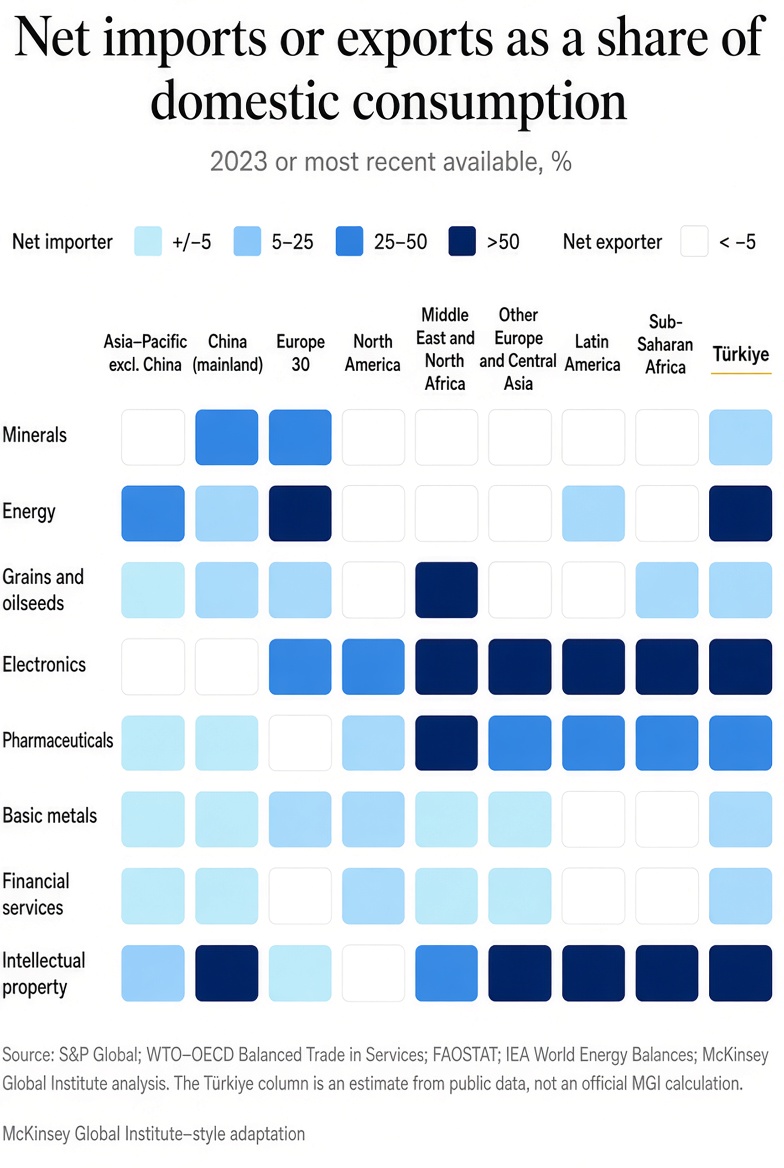
Turkey’s production of unmanned aerial vehicles (UAVs), land vehicles, and munitions represents a genuine industrial capability. However, this capability relies on three “invisible inputs”: energy, specialty metals/electronics, and intellectual property. In the chart, the color deepens—indicating increased vulnerability—precisely in these three areas. Why does the situation appear vulnerable?
Electronics and IP
Even if the UAV airframe is domestically produced, components such as flight controls, sensors, cameras, communication systems, software, and chips often depend on imported licenses or foreign designs. These are the first items to be cut off during wartime or under sanctions. Net imports in intellectual property measure the gap between “we manufacture” and “we control the design and critical software.”
Base metals
Steel production is substantial, yet in years like 2023, the country appears as a net importer; Electric Arc Furnace (EAF) facilities rely on scrap metal. Armor steel, titanium, copper, rare earth elements, and specialty alloys present a different set of challenges. While raw steel is abundant, high-quality inputs act as a bottleneck.
Energy
This factor is even more critical than the defense industry itself. Refining, electricity generation, logistics, and fertilizer supply chains rely on imported gas and oil. Even if vehicle and drone factories are operational, production halts if fuel and electricity supplies are cut off.
Food
Turkey is an agricultural country; There is export strength in fruits and vegetables, baked goods, and pasta. However, the “grain and oilseed” category in the chart measures raw materials. The milling and animal feed industries rely on imported wheat, soy, and oilseeds. In the event of a disaster or war, the problem is not a total lack of food, but rather a simultaneous crunch involving the quartet of cheap raw materials, logistics, energy, and foreign currency. Dependence on Black Sea wheat in 2022–23 demonstrated this.
Note: The color-coding for Turkey does not reflect McKinsey’s official data; it is an estimate based on data from the IEA, CBRT, FAO/USDA, and foreign trade statistics.